Artificial Intelligence (AI) is changing the way businesses work across the United Arab Emirates. From government organizations to private companies, many are investing in AI to improve efficiency, reduce costs, and create better customer experiences.
However, adopting AI successfully requires more than just buying new tools. Businesses need the right strategy, data, technology, skills, and governance. This is where an AI readiness assessment in UAE becomes important.
An AI readiness assessment helps organizations understand their current capabilities, identify gaps, and create a clear roadmap for AI adoption. It also helps businesses measure their level of AI maturity and prepare for long-term success.
This guide explains AI readiness in UAE, how AI readiness works, what AI maturity means, why many assessments fail, and how UAE enterprises can evaluate their readiness before scaling AI initiatives.
The Growing Importance of AI Readiness in UAE
The future of AI in the UAE is growing at an incredible speed. The country has become one of the leading adopters of AI technologies in the Middle East. Government agencies and businesses are actively exploring AI-powered solutions to improve operations and accelerate growth.
But before implementing AI across your organization, it is important to ask a simple question:
Is your business truly ready for AI?
Many companies rush into AI projects expecting immediate results. Unfortunately, without proper preparation, these projects often struggle due to:
- Poor data quality
- Lack of AI strategy
- Limited AI expertise
- Weak governance policies
- Unclear business goals
An effective AI readiness assessment in UAE helps businesses avoid these challenges and build a strong foundation for successful AI adoption.
Overview of the UAE AI Market Report
The UAE artificial intelligence market is experiencing remarkable growth, creating significant opportunities for businesses across industries. As organizations accelerate their digital transformation initiatives, AI technologies are becoming a key driver of innovation, productivity, and business growth throughout the country.
According to recent market research, the UAE AI market generated USD 7.82 billion in revenue in 2025 and is projected to reach USD 97.45 billion by 2033, growing at a strong CAGR of 36.3% from 2026 to 2033.
UAE AI Market Report Scope
| Market Indicator | Value |
| Market Revenue (2025) | USD 7,820.0 Million |
| Revenue Forecast (2033) | USD 97,450.5 Million |
| Growth Rate | CAGR of 36.3% (2026–2033) |
| Largest Segment | Services |
| Fastest-Growing Segment | Services |
| Historical Data | 2021–2024 |
| Base Year | 2025 |
| Forecast Period | 2026 – 2033 |
| Market Segmentation | Hardware, Software, Services |
The services segment currently holds the largest share of the UAE AI market and is also expected to witness the fastest growth during the forecast period. This growth is being driven by increasing demand for AI consulting, implementation, integration, and managed services as organizations seek expert guidance to deploy AI successfully.
The UAE accounted for approximately 2.0% of the global artificial intelligence market revenue in 2025, highlighting its growing influence in the global AI ecosystem. Furthermore, the UAE is expected to be the fastest-growing AI market in the Middle East and Africa region, with strong government support, increasing enterprise adoption, and continued investments in emerging technologies.
This rapid market expansion highlights why UAE AI Readiness has become a critical priority for organizations looking to remain competitive, accelerate innovation, and unlock the full potential of artificial intelligence.
How Does AI Readiness Work?
Many organizations believe that being excited about AI means they are ready for AI. In reality, enthusiasm alone is not enough.
AI Readiness in UAE focuses on evaluating whether an organization has the right foundation to successfully adopt and scale AI technologies.
An AI readiness process usually includes:
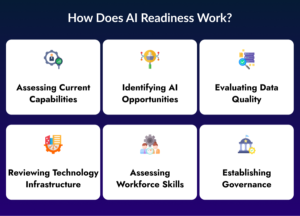
- Assessing Current Capabilities: Organizations evaluate their existing systems, data, processes, and workforce to understand where they stand today.
- Identifying AI Opportunities: Businesses determine which departments or processes can benefit the most from AI.
- Evaluating Data Quality: AI depends on data. Organizations must ensure their data is accurate, complete, and accessible.
- Reviewing Technology Infrastructure: Companies need scalable infrastructure that can support AI applications and future growth.
- Assessing Workforce Skills: Employees should have the knowledge and training needed to work effectively with AI systems.
- Establishing Governance and Security: Organizations must create policies to manage AI responsibly while protecting sensitive data.
What is AI Maturity?
AI readiness and AI maturity are closely connected, but they are not the same. AI readiness measures whether a company is prepared to start or expand AI initiatives. AI maturity measures how advanced and integrated AI has become within the organization.
An AI Maturity Assessment helps businesses understand their current stage in the AI journey and what steps they need to take next. It provides a structured framework for evaluating capabilities, identifying gaps, and planning future improvements.
For organizations seeking an enterprise AI maturity assessment in UAE, understanding these stages is essential.
Phases of AI Maturity
1. Awareness Phase
At this stage, companies are learning about AI and exploring its potential benefits.
Characteristics include:
- Basic understanding of AI
- Initial discussions about AI adoption
- Limited investment in AI technologies
2. Experimentation Phase
Organizations begin testing AI through pilot projects and proof-of-concept initiatives.
Characteristics include:
- Small AI projects
- Limited business integration
- Early learning and evaluation
3. Operationalization Phase
AI solutions become part of everyday business operations.
Characteristics include:
- AI integrated into workflows
- Governance frameworks established
- Dedicated AI teams formed
4. Optimization Phase
Businesses continuously improve AI systems using performance data and automation.
Characteristics include:
- Advanced analytics
- Continuous model improvement
- Increased automation across departments
5. AI-Powered Enterprise Phase
AI becomes a core part of business strategy and decision-making.
Characteristics include:
- Enterprise-wide AI adoption
- Data-driven culture
- AI integrated across all departments
- Continuous innovation through AI
Organizations conducting an AI maturity assessment of businesses in Dubai often use these phases to measure progress and plan future investments.
Why Most AI Readiness Assessments Fail to Drive Change
Many companies complete an AI assessment but fail to achieve meaningful results afterward. The problem is not the assessment itself. The problem is what happens after the assessment.
Here are the most common reasons why AI readiness assessments fail:
- Lack of Executive Commitment: Without leadership support, AI projects often lose momentum and funding.
- No Clear Business Goals: Organizations focus on technology instead of solving real business problems.
- Poor Data Quality: Even the best AI tools cannot produce valuable results from inaccurate or incomplete data.
- Skills Gaps: Employees may not have the knowledge needed to use AI effectively.
- Weak Governance: Without proper governance, businesses face compliance, security, and ethical risks.
- No Action Plan: Many assessments identify problems but fail to create a practical roadmap for improvement.
A successful AI readiness assessment in UAE should not end with a score. It should provide clear recommendations, priorities, and next steps that help businesses move forward confidently.
AI Readiness Checklist for UAE Enterprises
This practical framework can help executives conduct an initial enterprise AI maturity assessment in UAE.
Rate each area on a scale from 1 to 5:
- 1 = Low Readiness
- 5 = High Readiness
| AI Readiness Pillar | Key Questions | Score (1-5) |
| AI Strategy & Leadership | Do you have a clear AI strategy aligned with business goals? Is executive support available? | |
| Data & Infrastructure | Is your data accurate, accessible, and AI-ready? Is your infrastructure scalable? | |
| Talent & Skills | Do you have AI talent internally? Are employees receiving AI training? | |
| Governance & Compliance | Do AI initiatives comply with local regulations? Do governance policies exist? | |
| Use Cases & Business Value | Have high-impact AI use cases been identified? Is ROI clearly defined? | |
| Change Management & Adoption | Are employees ready to adopt AI? Is the organization prepared for change? |
Understanding Your Score
- 24-30 Points: High AI Readiness
Your organization has a strong foundation and is ready to scale AI initiatives.
- 18-23 Points: Moderate AI Readiness
You have made good progress but still need improvements in key areas.
- 12-17 Points: Early AI Readiness
Your organization should strengthen its foundations before large-scale AI deployment.
- Below 12 Points: Low AI Readiness
Focus on strategy, data, infrastructure, and workforce development before investing heavily in AI.
Industry-Specific AI Readiness Considerations in the UAE
Every industry has different AI requirements. While the goal of AI adoption may be similar, the readiness factors vary depending on business operations, regulations, and technology needs. When conducting an enterprise AI readiness assessment in UAE, organizations should consider industry-specific requirements.
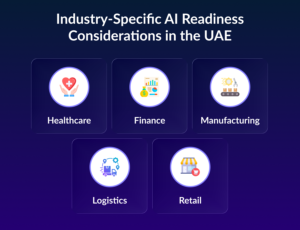
1. Healthcare: Protecting Sensitive Patient Data
Healthcare organizations handle large amounts of sensitive patient information, making data security a top priority. AI readiness in this sector requires secure cloud infrastructure, strong encryption methods, and compliance with healthcare regulations to ensure patient privacy and trust.
2. Finance: Strong Governance and Regulatory Compliance
Financial institutions must follow strict regulations when implementing AI solutions. To achieve AI readiness, banks need transparent AI models, strong governance frameworks, cybersecurity controls, and proper risk management processes that align with UAE financial laws.
3. Manufacturing: Reliable Sensors and IoT Infrastructure
For manufacturers, AI success depends on accurate real-time data collected through sensors and IoT devices. Companies need connected equipment, predictive maintenance capabilities, and a strong digital infrastructure to support smart factory operations.
4. Logistics: Seamless Integration with Existing Systems
Logistics companies rely on multiple systems to manage supply chains and transportation operations. AI readiness requires smooth integration with ERP platforms, real-time tracking systems, and scalable cloud solutions that improve efficiency and route optimization.
5. Retail: Accurate and Actionable Data
Retail businesses generate valuable customer, inventory, and sales data every day. To unlock AI-driven insights, organizations need clean and accurate data, demand forecasting capabilities, and personalized customer engagement strategies across all sales channels.
How to Conduct an AI Readiness Assessment?
A structured assessment helps organizations understand where they stand and what improvements are needed before implementing AI at scale.
Step 1: Define Business Objectives
The first step is identifying what you want AI to achieve for your business. Whether your goal is to improve customer experience, increase efficiency, or reduce costs, having clear objectives helps guide AI investments and decision-making.
Step 2: Evaluate Data Readiness
AI depends heavily on data quality. Businesses should assess whether their data is accurate, organized, accessible, and suitable for AI applications before launching any AI initiative.
Step 3: Assess Technology Infrastructure
Organizations need to evaluate whether their existing systems can support AI implementation. This includes reviewing cloud capabilities, storage capacity, security measures, and system integration readiness.
Step 4: Assess Skills and Talent
A successful AI strategy requires skilled employees who understand AI technologies. Companies should evaluate existing expertise and invest in training, certifications, and upskilling programs where needed.
Step 5: Review Governance and Compliance
AI systems must comply with local regulations and industry standards. Organizations should establish governance frameworks that address data privacy, security, transparency, and ethical AI practices.
Step 6: Create an AI Roadmap
After completing the assessment, businesses should develop a practical roadmap that outlines priorities, timelines, required investments, and measurable goals for AI implementation.
AI Readiness Challenges in the UAE
Despite strong interest in AI adoption, many organizations face challenges when implementing AI initiatives.
1. Legacy Systems and Data Silos
Many UAE businesses still rely on outdated systems that do not communicate effectively with each other. This creates data silos, making it difficult to access and analyze information across departments.
How to Overcome?
Organizations should modernize their technology stack, build centralized data platforms, and implement integration strategies that enable smooth data sharing across the business.
2. Talent Shortage
The demand for AI specialists in the UAE continues to grow, but skilled professionals remain limited. Many organizations struggle to find experienced AI engineers, data scientists, and machine learning experts.
How to Overcome?
Businesses can combine external expertise with internal talent development by investing in AI training, certification programs, and hands-on projects that build long-term capabilities.
3. Budget Constraints
AI projects often require investments in infrastructure, software, and skilled talent. Without a clear understanding of ROI, leadership teams may hesitate to move forward with large-scale AI initiatives.
How to Overcome?
Start with small pilot projects that deliver measurable results. Cloud-based AI solutions can also help reduce upfront infrastructure costs while demonstrating business value.
4. Change Management Resistance
Employees may worry that AI will replace jobs or significantly change existing workflows. This uncertainty can slow adoption and create resistance across teams.
How to Overcome?
Organizations should communicate openly about AI goals, involve employees early in the process, and provide training that helps teams understand how AI supports rather than replaces their work.
Future Trends in the UAE AI Landscape
AI adoption in the UAE is continuing to evolve. Several important trends are shaping the future of AI across industries.
1. Arabic Language AI Models
AI solutions are increasingly being developed with Arabic language support at their core. These models better understand regional dialects, cultural nuances, and communication patterns, making AI more effective for businesses across the UAE.
2. UAE AI Strategy 2031
The UAE government continues to invest heavily in AI through its long-term vision and national initiatives. These efforts are accelerating AI adoption across healthcare, education, transportation, and public services.
3. AI-Powered Smart Cities
Cities like Dubai and Abu Dhabi are expanding their smart infrastructure initiatives. AI is helping improve traffic management, energy efficiency, public safety, and urban planning, creating new opportunities for businesses.
4. Increased Focus on AI Governance
As AI adoption grows, organizations are placing greater emphasis on responsible AI practices. Governance, transparency, security, and compliance will become critical components of every AI strategy.
5. AI-Driven Enterprise Transformation
Businesses are moving beyond basic automation and adopting AI across entire organizations. AI is becoming a key driver of decision-making, customer engagement, operational efficiency, and innovation.
Why Developer Bazaar Technologies is the Right Partner for Your AI Readiness Journey?
Developer Bazaar Technologies helps businesses navigate every stage of their AI transformation journey. As an experienced AI development company, we assess your current capabilities, identify readiness gaps, and create a practical roadmap tailored to your business goals.
Industry-Focused AI Readiness Frameworks
Our team uses proven frameworks to evaluate AI maturity across different industries. This helps organizations understand where they stand and what steps are needed to achieve long-term AI success.
Comprehensive Readiness Assessment
We analyze your AI strategy, data quality, infrastructure, workforce skills, and governance practices. This provides a complete picture of your organization’s readiness level.
Scalable AI Solutions
Our solutions are designed to grow alongside your business. We build flexible and scalable AI systems that support future innovation and evolving business needs.
Compliance and Security Focus
We help businesses implement AI responsibly by ensuring compliance with data privacy requirements, governance standards, and industry regulations.
End-to-End Support
From strategy and assessment to implementation and optimization, our experts provide continuous support to help organizations maximize the value of their AI investments.
Conclusion
AI is rapidly reshaping industries across the UAE, creating new opportunities for growth and innovation. However, organizations must first understand their readiness level, address capability gaps, and develop a clear implementation strategy before scaling AI initiatives.
Conducting an AI readiness assessment in UAE helps businesses reduce risks, maximize AI investments, and build a strong foundation for future success. By partnering with an experienced AI development company like Developer Bazaar Technologies, organizations can accelerate their AI journey and stay ahead in an increasingly AI-driven economy.
FAQs
1. What is the UAE AI Strategy 2031?
The UAE AI Strategy 2031 aims to make the UAE one of the world’s leading AI-ready nations. The strategy focuses on using AI to increase economic growth, improve government services, drive innovation, and build a sustainable technology-driven economy.
2. Why is assessing AI Readiness in Dubai important?
Assessing AI readiness helps organizations identify strengths, address weaknesses, and create a structured roadmap for successful AI adoption. It reduces implementation risks and improves the chances of achieving measurable business outcomes.
3. How long does an AI readiness assessment typically take?
The timeline depends on the size and complexity of the organization. For most businesses, an AI readiness assessment can take anywhere from a few weeks to a couple of months, depending on the number of departments, systems, and data sources being evaluated.
4. Who should be involved in an AI readiness assessment?
An effective assessment should involve business leaders, IT teams, data specialists, compliance officers, and department heads. Involving multiple stakeholders ensures that both technical and business requirements are considered when planning AI initiatives.
5. Can small and mid-sized businesses benefit from AI readiness assessments?
Yes. AI readiness assessments are valuable for businesses of all sizes. They help small and mid-sized companies identify practical AI opportunities, avoid unnecessary investments, and create a roadmap that aligns with their budget and growth objectives.
6. How often should organizations evaluate their AI readiness?
Organizations should review their AI readiness regularly, especially when introducing new technologies, expanding operations, or launching digital transformation initiatives. Many businesses conduct a reassessment every 12 to 24 months to track progress and adapt to changing requirements.
7. How can an AI Development company help with AI readiness?
An experienced AI Development company can evaluate your current capabilities, identify readiness gaps, recommend the right technologies, and create a strategic roadmap for implementation. This ensures a smoother and more successful AI adoption journey.